QR Payment Cost Calculator
QR payments charge as little as 0.2% compared to 1.5%-3% for credit cards. This means significant savings for small businesses.
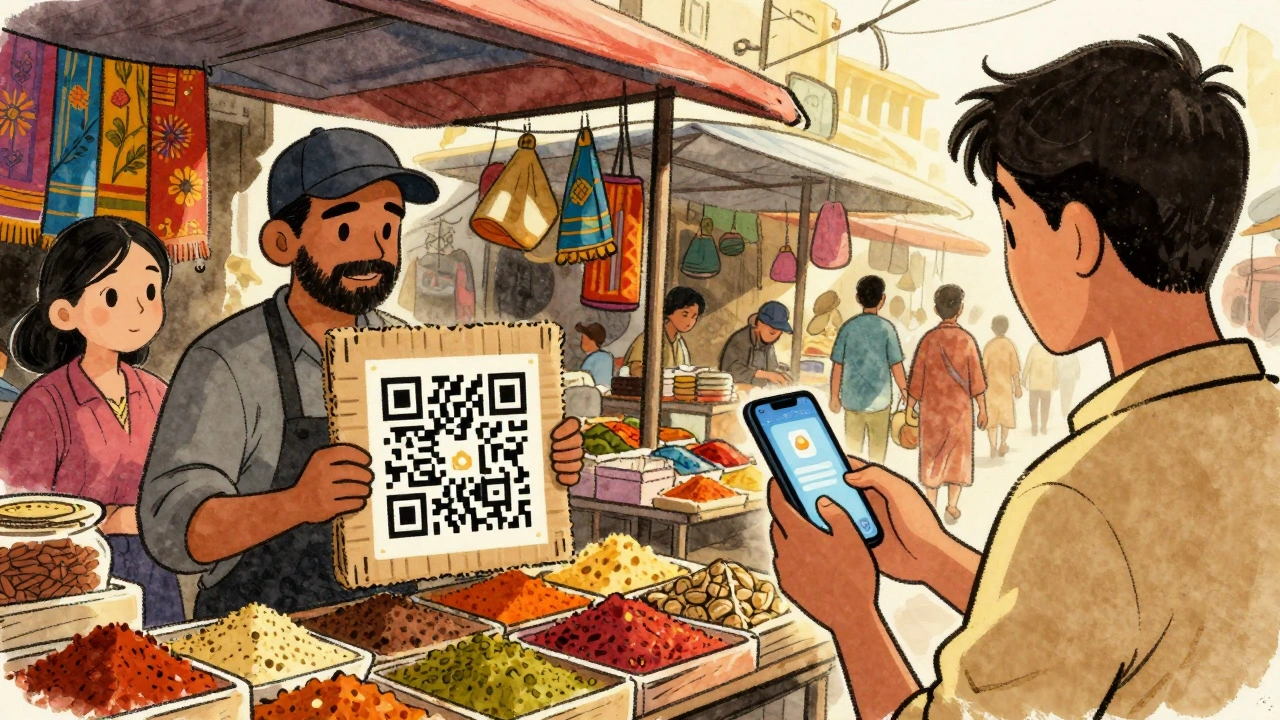
The article shows that street vendors in Southeast Asia save hundreds monthly by switching to QR code payments.
Your Potential Savings
Credit Card Fees (1.5-3%)
$0.00
QR Payment Fees (0.2%)
$0.00
Total Monthly Savings
$0.00
Enough to buy 2 coffee cups every day.
Scanning a QR code to pay for coffee used to feel like a gimmick. Now, it’s how millions of people buy groceries, pay rent, and tip their baristas. In 2025, QR code payments aren’t just growing-they’re reshaping how money moves, especially where credit cards never reached. You don’t need a terminal, a bank account, or even a smartphone with NFC. Just a camera and an app. That’s the quiet revolution happening in alleyway stalls in Mumbai, family-run shops in Bogotá, and even your local farmers market in Asheville.
How QR Payments Actually Work (No Tech Jargon)
There are two ways this works in real life. The first is when the merchant shows you a QR code-printed on a sign, displayed on a tablet, or even taped to a counter. You open your phone’s camera or payment app, scan it, enter the amount (if needed), and hit pay. That’s merchant-presented mode. It’s what you see at street food carts in Thailand or small boutiques in Seoul.
The second way is when you show your phone to the merchant. Your app generates a dynamic, one-time QR code with your payment details. They scan it with their device. This is consumer-presented mode. It’s common in places like India’s UPI system, where you pay a vendor by showing your phone screen. Neither method needs special hardware. No card readers. No PIN pads. Just a phone and a code.
Behind the scenes, EMVCo-the group that also sets standards for chip cards-built global rules for these codes. That means a QR code from your PayPal app can work at a store that uses Google Pay, as long as both follow the same technical blueprint. It’s not magic. It’s standardization.
Why QR Codes Beat Credit Cards in Many Places
Why did QR payments explode in Asia but lag in the U.S.? The answer is cost and access. A single NFC terminal costs $50 to $200. A printed QR code? Five cents. For a street vendor earning $10 a day, that’s the difference between accepting payments and losing sales.
Transaction fees tell the same story. Credit card processors charge 1.5% to 3% per transaction. QR code systems, especially in countries with national payment rails like India’s UPI or Thailand’s PromptPay, charge as little as 0.2%-sometimes nothing at all. That’s why 81% of small businesses in Southeast Asia now use QR codes. They’re not just convenient-they’re survival tools.
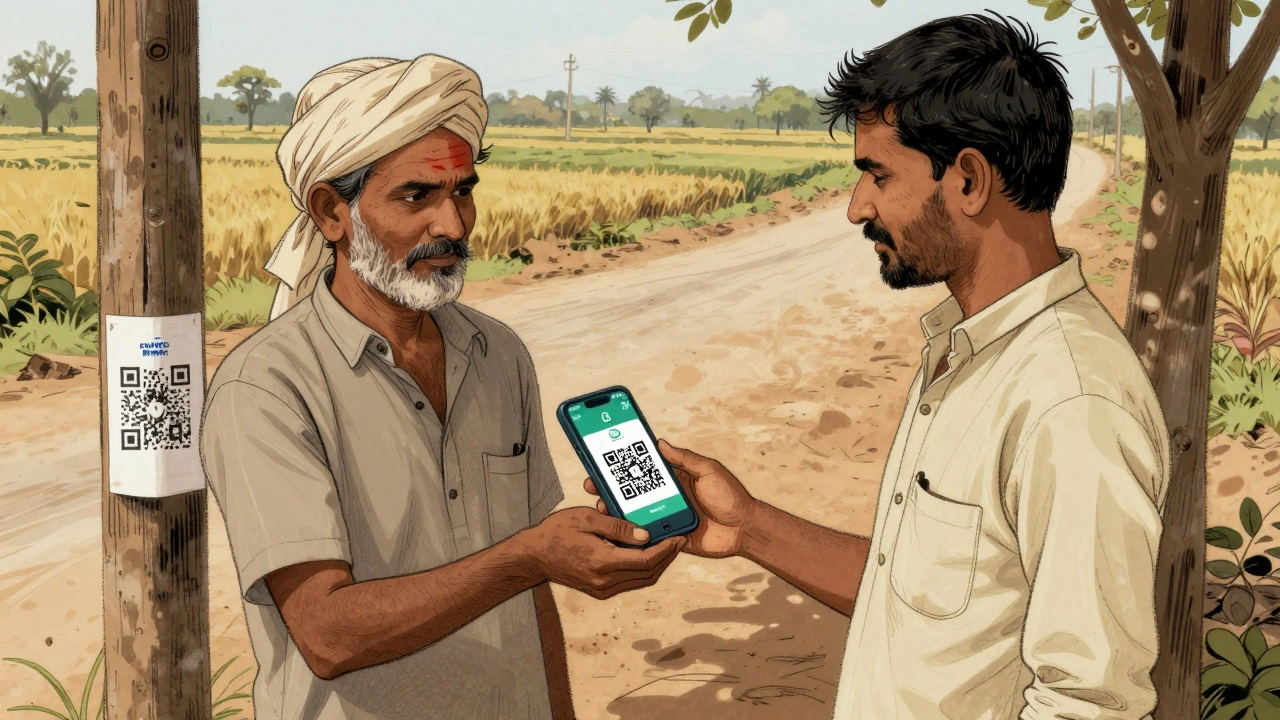
And it’s not just about money. In rural areas where banks don’t have branches, QR payments connect people to the financial system. A farmer in Bihar can receive payment from a buyer in Delhi without ever visiting a bank. A grandmother in Manila can send money to her grandchild using a QR code shared over WhatsApp. This isn’t innovation for the sake of tech-it’s financial inclusion built into a simple square.
The U.S. Is Catching Up-Slowly
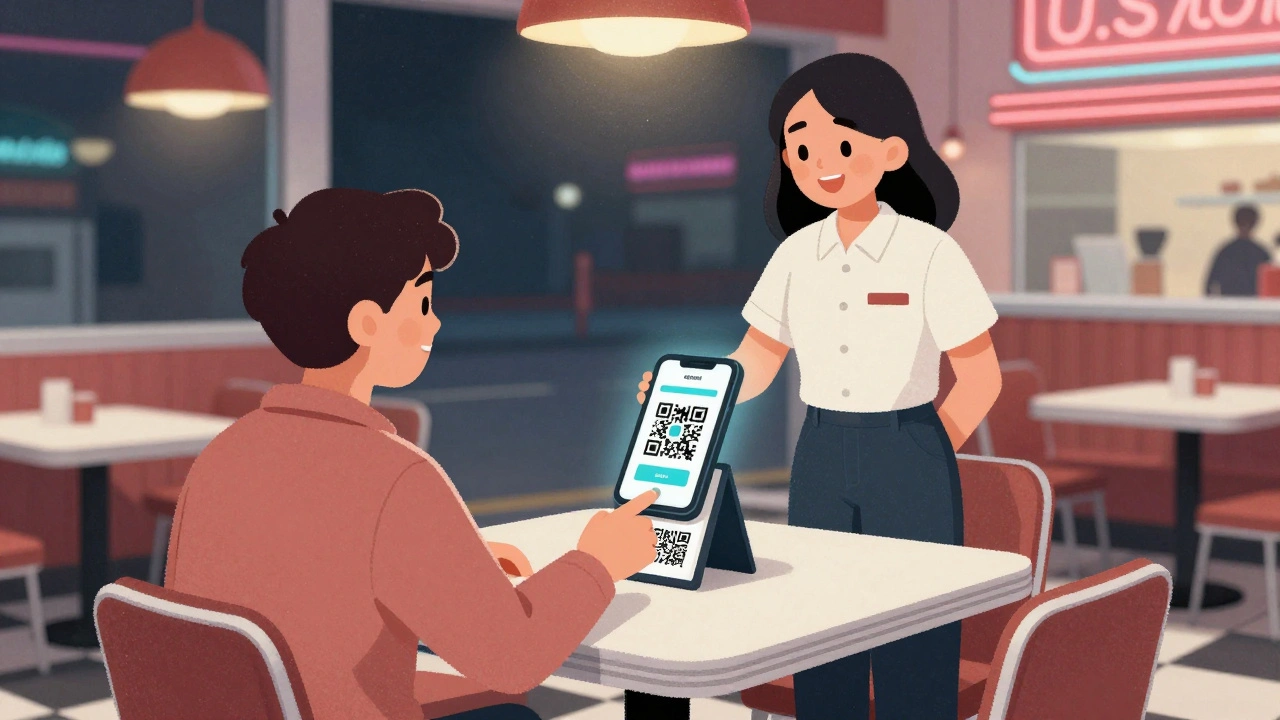
In the U.S., QR payments are still niche. Most people still tap their phone or card. But that’s changing. By 2025, over 100 million Americans are expected to use QR codes for payments, according to Sycurio. Why? Because apps like PayPal, Apple Pay, and Google Pay now support them. You can scan a QR code at a diner in Nashville and pay directly from your Apple Wallet. No extra app needed.
Big retailers are testing it too. Walmart, Target, and CVS have started putting QR codes on receipts so you can pay for returns or top up gift cards. Restaurants use them for split bills. Even parking meters in some cities now accept QR payments instead of coins.
But adoption isn’t smooth. One in five users complain about scanning issues in dim light. One in three merchants say codes get damaged, taped over, or ignored. And there’s confusion-some codes are static (always the same), others are dynamic (change with each payment). If you scan a static code for $50 but the merchant meant $10, you’re out $40. That’s why newer systems now require you to confirm the amount before sending.
What’s Next? AI, Offline Payments, and Biometrics
QR codes aren’t staying simple. The next wave is smarter, safer, and works even without internet.
Companies are testing offline QR payments. Imagine paying for a bus ride in a tunnel, or buying water from a kiosk in a remote village with no signal. New protocols let your phone store encrypted payment data locally. The transaction syncs later when you’re back online. Over 78% of payment providers are building this feature, according to Sycurio.
Security is getting a boost too. EMVCo released new specs in Q2 2025 that allow biometric authentication-fingerprint or face ID-to lock payments. No more typing a PIN on a public screen. Just scan and unlock with your face. Thirty-seven major processors, including Stripe and Square, started rolling this out in Q3 2025.
And it’s not just payments. QR codes are becoming the glue for smart cities. Singapore’s public transit system runs on QR scans-8.2 million rides a day. In Barcelona, you scan a code to pay for parking. In Atlanta, municipal fines can be settled with a QR code on your ticket. These aren’t gimmicks. They’re infrastructure.
The Real Limitation: Fragmentation
Here’s the catch: QR payments don’t speak the same language everywhere. China uses Alipay and WeChat Pay. India uses UPI. Thailand uses PromptPay. The U.S. has a patchwork of PayPal, Venmo, and bank apps. Europe is still building its own standard under PSD3.
That means a QR code from your UPI app won’t work in Japan. A code from your PayPal app might not scan at a small shop in Mexico that only accepts local wallet apps. This fragmentation slows global adoption. It’s like having five different Wi-Fi passwords for the same house.
EMVCo’s QR Payment Mark, launched in late 2024, is trying to fix this. It’s a simple logo-like a Visa or Mastercard symbol-that tells you the code follows global standards. So far, 42% of major retailers in Asia-Pacific have started using it. If it catches on, you’ll be able to scan any QR code with the mark and know it’ll work, no matter where you are.
What This Means for You
If you’re a consumer: Start using QR payments. They’re faster than cash, cheaper than cards, and work where other systems don’t. Don’t wait for your bank to push it-your phone already has the tools. Open your PayPal or Google Pay app, find the QR scan option, and try it at your next small business visit.
If you run a business: Setting up QR payments takes less than 15 minutes. You don’t need a credit card terminal. Just use your existing payment app (Stripe, Square, PayPal) to generate a code. Print it. Tape it to the counter. Done. You’ll attract more customers, especially younger ones who prefer digital. And you’ll save hundreds a month in processing fees.
If you’re in a developing country: QR payments are your gateway to the formal economy. No bank? No problem. Use a mobile wallet. Even a basic phone can do it. Millions already have.
Is This the Future? Or Just a Phase?
Gartner says QR payments might plateau after 2028 as wearables and biometric payments take over. But that’s like saying email died when texting arrived. QR codes aren’t the end-they’re the foundation. They’re the TCP/IP of mobile payments, as one analyst put it. You don’t need to understand how the internet works to send an email. You just click send. Same with QR codes.
Even if Apple releases a new ring that lets you pay with a flick of your finger, QR codes will still be there. In rural clinics. On bus tickets. In refugee camps. In places where fancy tech doesn’t reach. They’re cheap, simple, and universal.
The future of payments isn’t about which gadget wins. It’s about making money move as easily as a text message. QR codes already do that. And they’re just getting started.
Can I use QR code payments in the U.S. right now?
Yes. Major apps like PayPal, Google Pay, Apple Pay, and Venmo all support QR code payments. You can scan codes at many restaurants, gas stations, and small shops. Some stores even have QR codes on receipts to pay for returns or reload gift cards. You don’t need a special app-just use your existing digital wallet.
Are QR payments safer than credit cards?
It depends. Traditional credit cards use chip-and-PIN or NFC with encryption, which most consumers trust more. But QR payments now include biometric locks (fingerprint or face ID), one-time codes, and tokenization-meaning your actual card number isn’t shared. Newer systems are just as secure. The bigger risk is scanning fake codes. Always double-check the amount before confirming a payment.
Do I need an internet connection to use QR payments?
Most do, but not all. Newer systems support offline payments. Your phone stores encrypted payment data locally. When you scan a code, the transaction is held and sent later when you regain internet. This is being rolled out in rural areas and transit systems where connectivity is unreliable.
Why do some QR codes work and others don’t?
Because not all QR codes follow the same standards. Older codes are static and tied to one account. Newer ones are dynamic and encrypted. Some are built for specific apps (like Alipay or UPI) and won’t work outside their ecosystem. Look for the EMVCo QR Payment Mark-a small logo that means the code follows global standards and should work with most apps.
Can I use QR payments without a bank account?
Yes. In many countries, you can link a QR payment app to a mobile wallet funded by cash deposits at local kiosks or convenience stores. In India, millions use UPI without a traditional bank account. In Nigeria and Kenya, mobile money systems like M-Pesa work the same way. It’s not about having a bank-it’s about having a phone.
How do I set up QR payments for my small business?
If you already use PayPal, Square, Stripe, or another digital payment provider, log into your dashboard. Look for the QR code option. Generate a static or dynamic code, print it, and place it where customers can scan it. Setup takes less than 15 minutes. No hardware needed. You’ll get paid directly to your bank or wallet. Some providers even let you customize the code with your logo.

Comments (5)
Julia Czinna
Just scanned a QR code to pay for my latte this morning-no app switch, no fumbling for cards, just open wallet, point, tap. It’s wild how something so simple feels revolutionary when you’ve spent years wrestling with card readers that spit out receipts sideways.
I’ve started using it at my local farmers market, and the vendor told me she’s processed more payments in the last three months than she did all last year. No fees. No terminals. Just a printed sticker and a phone.
It’s not flashy, but that’s the point. It doesn’t need to be. It just works.
And honestly? I think this is what financial inclusion actually looks like-not a blockchain whitepaper, but a grandmother in Kerala sending money to her grandson using a QR code shared over WhatsApp.
Small, quiet, unstoppable.
Astha Mishra
Let me tell you, in India, UPI didn’t just change payments-it rewrote the social contract around money. My aunty, who never had a bank account, now uses her basic Android phone to pay for groceries, send money to her sister in Mumbai, and even pay her electric bill-all through a QR code. She doesn’t know what ‘tokenization’ or ‘EMVCo’ means, but she knows that if she scans the code and sees the right amount, she hits ‘confirm’ and it’s done.
And you know what? She’s safer now. No cash on her, no one asking for her Aadhaar number, no middleman taking a cut. The system is dumb-simple, and that’s its genius.
I remember when we used to wait in line for hours to deposit cash at the bank. Now, a farmer in Bihar gets paid the moment his vegetables are loaded onto the truck. No bank branch. No paperwork. Just a code.
This isn’t tech innovation. This is dignity, digitized.
And yet, I still see people in Delhi arguing about ‘security’ like it’s 2008. The real risk isn’t the QR code-it’s the lack of awareness. Teach people how to spot a fake code, and this becomes the most democratic financial tool ever built.
Also, the EMVCo mark? Finally. Someone in a suit got it right for once.
India didn’t invent QR payments, but we turned them into a people’s movement. And honestly? The rest of the world is still catching up.
Dave McPherson
Oh wow. Another ‘QR codes are the future’ thinkpiece. How novel. Let me grab my crystal ball-oh wait, I don’t need one, I just need to look at the actual data.
Yes, QR payments are ‘cheap’-but they’re also clunky, insecure, and a nightmare for customer service. I’ve scanned a code that charged me $400 because the merchant taped over the original $40 one. No confirmation. No audit trail. Just a silent, digital heist.
And don’t get me started on the ‘offline’ nonsense. You’re telling me I’m supposed to trust my phone to store encrypted payment data… in a tunnel? In a rural village? With a $150 Android that gets hot if you open Instagram?
Meanwhile, NFC works everywhere. It’s fast. It’s encrypted. It’s standardized. Apple Pay doesn’t need you to squint at a blurry code in the rain. You just tap. Done.
QR codes are the Excel of payments-functional, but only because nobody had the budget for anything better. And now we’re pretending it’s ‘financial inclusion’? Please. It’s just the last gasp of underfunded infrastructure.
Also, ‘EMVCo QR Payment Mark’? That’s like slapping a ‘Certified Organic’ sticker on a can of spam. Doesn’t make it better. Just makes it louder.
RAHUL KUSHWAHA
My uncle in rural Bihar used QR code to get paid for his rice harvest last week. No bank. No card. Just his phone and a code from the buyer. He smiled and said, ‘Ab paisa seedha ghar aata hai.’
Simple. Safe. Real.
:-)
Graeme C
Dave, you’re not wrong about the clunkiness-but you’re missing the point entirely. This isn’t about whether QR codes are ‘better’ than NFC. It’s about accessibility. You live in a world where every corner store has an NFC reader and your phone has a $1,000 chip. Most of the world doesn’t.
My cousin runs a tiny café in Glasgow. She used to pay £200/month in card fees. Now? She prints a QR code for £2. Her profit margin doubled. Her customers love it. And guess what? The old guy who still pays in cash? He doesn’t care how it works-he just likes that he doesn’t have to fumble for change anymore.
QR codes aren’t the pinnacle of tech. They’re the bridge. And bridges aren’t glamorous. They’re just necessary.
Also, ‘EMVCo QR Payment Mark’? That’s the first time a standards body did something right without corporate lobbying. Give them a medal.
And Julia? You’re right. It’s the quiet revolution. Not the one with the keynote speech. The one where a street vendor in Manila finally stops being paid in IOUs.
That’s the future. And it’s already here.